
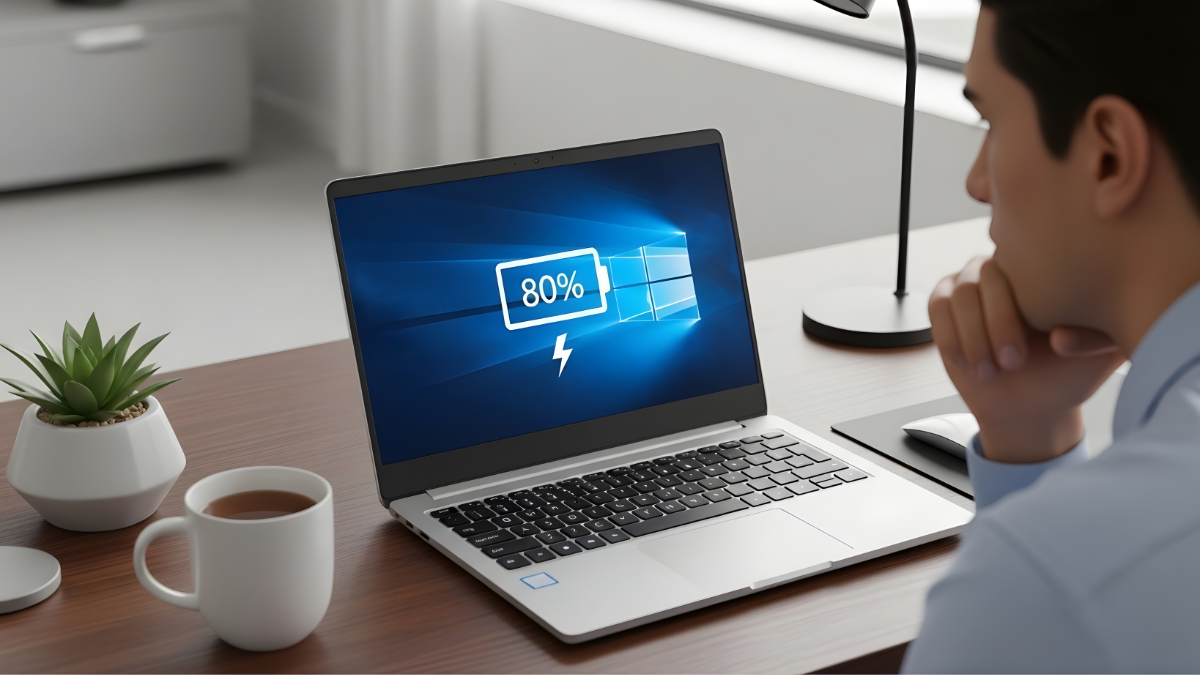
It can be incredibly frustrating to plug in your device only to find your laptop battery not charging to 100%. You might see your laptop battery stuck at 80% or perhaps 95%, leaving you wondering if your hardware is failing or if your settings are broken.
In most cases, a laptop battery not fully charging isn’t actually a sign of a broken battery. Modern manufacturers like Dell, HP, and Lenovo often include “smart charging” features designed to extend the lifespan of your device. However, if you need that full 100% charge for a long flight or a day away from an outlet, you need to know how to override these limits.
Read more: Windows 11 WiFi Connected But No Internet (10 Easy Fixes)
Read more: Windows Update Stuck at 0 Percent (8 proven Fixes)
Read more: Laptop Fan Very Loud Suddenly? 10 Easy Fixes That Work
This guide will walk you through why your laptop stops charging before 100% and provide practical, easy-to-follow steps to fix your laptop battery charging problem.
Why Your Laptop Battery Is Not Charging to 100%
Before diving into the fixes, it’s important to understand the “why.” If your battery stops at a specific number every time, it is likely a software setting rather than a hardware failure.
1. Battery Health Protection Features
Lithium-ion batteries are chemically stressed when kept at 100% charge for long periods, especially while plugged into a wall outlet. To combat this, many brands use battery limit charging in Windows to cap the charge at 80%.
2. Manufacturer-Specific Battery Limit Settings
Companies like Lenovo (Vantage) and Dell (Power Manager) have proprietary software that manages power. If “Conservation Mode” or “Peak Shift” is enabled, your battery will intentionally stop charging early.
3. Windows Power Management Settings
Sometimes, the communication between the Windows operating system and the battery hardware gets “confused.” This usually happens after a major Windows update or if the drivers become outdated.
4. Battery Wear and Age
Over time, batteries lose their capacity to hold a charge. If your battery is several years old, it might report a lower maximum percentage because the cells can no longer reach their original design capacity.
5. BIOS Configuration
The BIOS (Basic Input/Output System) manages your hardware before Windows even starts. Some laptops have a battery charging limit set directly in the BIOS menu.

How to Fix Laptop Battery Not Charging to 100% (Step-by-Step)
Follow these solutions in order. We will start with the most common software settings and move toward more technical hardware recalibrations.
Fix 1: Check Battery Health Protection Settings
The most common reason for a laptop battery stuck at 80% is a feature called “Smart Charging” or “Battery Health Mode.”
-
Look for a battery icon in your taskbar that looks different from the standard Windows one.
-
Open your laptop manufacturer’s management app (e.g., MyASUS, LG Control Center, or Samsung Settings).
-
Look for a section labeled Power, Battery, or Battery Health.
-
Check if a “Battery Life Extender” or “Maximum Lifespan Mode” is turned on.
-
Switch it to “Full Capacity Mode” or “100% Charge.”
Fix 2: Disable Battery Charging Limit (Brand Specific)
If you own a Dell, Lenovo, or HP, these settings are often buried in specific tools.
-
For Lenovo Users: Open the Lenovo Vantage app. Go to Device > Power. Look for Conservation Mode. If it’s on, your battery will stay between 55% and 60%. Toggle it off.
-
For Dell Users: Open Dell Power Manager. Go to the Battery Information tab and click Settings. Ensure it is set to “Standard” rather than “Primarily AC Use” (which limits the charge).
-
For HP Users: HP uses HP Power Manager or settings within the BIOS called “Battery Health Manager.” Set this to “Maximize my battery duration” to allow a 100% charge.
Fix 3: Recalibrate the Laptop Battery
Sometimes the Windows battery meter simply loses track of where “zero” and “100” actually are. Recalibration resets the digital gauge.
-
Charge your laptop to its current maximum (e.g., 80% or 95%).
-
Unplug the charger and use the laptop until it dies completely and shuts down.
-
Leave it off for about 2–3 hours to ensure all residual power is gone.
-
Plug the charger back in and charge it to 100% without turning the laptop on.
-
Once the charging light indicates it is full, turn it on. Your Windows battery health settings should now show a more accurate percentage.
Fix 4: Update Battery Drivers in Windows
Outdated drivers can cause a laptop battery charging problem. You can refresh these through the Device Manager.
-
Right-click the Start button and select Device Manager.
-
Expand the Batteries section.
-
Right-click Microsoft ACPI-Compliant Control Method Battery.
-
Select Uninstall device (Don’t worry, Windows will reinstall this automatically).
-
Restart your laptop. Windows will detect the hardware and reinstall the fresh drivers.
Fix 5: Update Your BIOS
The BIOS controls how the motherboard interacts with the battery. Manufacturers often release BIOS updates specifically to fix charging bugs.
-
Go to the official support website for your laptop brand (e.g., support.dell.com or support.hp.com).
-
Enter your Serial Number or Model Number.
-
Download the latest BIOS Update or Firmware.
-
Run the installer (ensure your laptop is plugged into power during this process).
Brand-Specific Solutions for Charging Issues
Each manufacturer handles battery limit charging in Windows differently. Here is a breakdown for the major brands in the US.
Dell Laptops
Dell uses a feature called “Peak Shift” and “Advanced Charge.” These are intended to save electricity costs or battery wear by not charging during certain hours or past certain percentages. If your Dell is stuck, check the Dell Optimizer or Dell Power Manager apps.
HP Laptops
Many newer HP business laptops (EliteBooks and ProBooks) have a BIOS setting called Battery Health Manager. If set to “Let HP Manage My Battery Charging,” it may cap the charge at 80% if it detects the laptop is always plugged in. To change this, you must restart and tap F10 to enter the BIOS.
Lenovo Laptops
Lenovo is famous for “Conservation Mode.” This is highly recommended if you always keep your laptop on a desk, but it is the primary reason for a laptop battery not charging to 100%. Use the Lenovo Vantage app (available in the Microsoft Store) to toggle this off.
When is the Battery Actually Failing?
If you have tried all the software fixes and your laptop battery is still not fully charging, the hardware itself might be reaching the end of its life.
Signs of a Failing Battery:
-
The laptop shuts down suddenly even when it says 10% or 20% remains.
-
The battery area feels excessively hot while charging.
-
The “time remaining” estimate jumps wildly (e.g., from 2 hours to 20 minutes in an instant).
-
The battery casing looks “swollen” or the trackpad is lifting (Stop using the device immediately if this happens!).
How to Check Battery Health in Windows
Windows has a hidden tool that tells you exactly how much your battery has degraded.
-
Type cmd in the Windows search bar.
-
Right-click Command Prompt and select Run as Administrator.
-
Type the following command and press Enter:
powercfg /batteryreport -
Windows will generate a report and tell you where it is saved (usually
C:\Windows\system32\battery-report.html). -
Open that file in your web browser.
How to Read the Report: Look for Design Capacity vs. Full Charge Capacity.
-
Design Capacity: What the battery held when it was brand new.
-
Full Charge Capacity: What it can hold right now. If the Full Charge Capacity is significantly lower (e.g., 50% of the Design Capacity), it is time for a replacement.
7 Tips to Improve Laptop Battery Lifespan
Once you’ve solved your laptop battery charging problem, follow these tips to make sure your battery lasts for years to come:
-
Avoid Overheating: Heat is the #1 killer of batteries. Never use your laptop on a pillow or blanket where vents are blocked.
-
Use Original Chargers: Cheap third-party chargers can have inconsistent voltage, which damages the internal charging circuit.
-
Keep it Between 20% and 80%: If you don’t need the full 100%, keeping the battery in this “goldilocks zone” can double its lifespan.
-
Update Windows Regularly: Microsoft frequently releases patches for Windows battery health settings and power efficiency.
-
Unplug Occasionally: If you use your laptop as a desktop, unplug it once a week and let it drain to 20% to keep the electrons moving.
-
Dim Your Screen: Lowering brightness reduces the “discharge rate,” which puts less strain on the battery cells.
-
Store at 50%: If you aren’t going to use your laptop for a month, charge it to 50% and turn it off. Never store a battery at 0%.
Frequently Asked Questions (FAQ)
Why does my laptop stop charging at 80%?
This is usually due to a “Battery Protection” or “Conservation Mode” setting in your manufacturer’s software (like Lenovo Vantage or MyASUS). It is designed to extend the battery’s total lifespan.
Is it bad if my battery never reaches 100%?
No, it’s actually better for the battery’s chemical health. However, if you need maximum portability, you can disable the limit in your power settings.
How do I remove the battery charging limit?
You can usually find this toggle in your laptop’s brand-specific management app or by checking the “Power” section in your BIOS settings.
Can Windows updates cause battery issues?
Yes. Sometimes an update can glitch the battery driver. Uninstalling the “Microsoft ACPI-Compliant Control Method Battery” in Device Manager and restarting usually fixes this.
Should I replace my laptop battery?
If your battery report shows that your “Full Charge Capacity” is less than 60% of its “Design Capacity,” or if the laptop dies within 30 minutes of being unplugged, it is time for a replacement.
Conclusion
Finding your laptop battery not charging to 100% is usually not a cause for panic. Whether it’s a laptop battery stuck at 80% due to health settings or a minor driver glitch, most of these issues can be resolved in under 10 minutes.
Start by checking your manufacturer’s software for any battery limit charging in Windows, then move on to updating your drivers and recalibrating the hardware. By understanding why your laptop stops charging before 100%, you can take better care of your hardware and ensure your device is ready whenever you need to go mobile.