




Understanding Return on Investment (ROI) in Higher Education
What Does ROI Mean for College Students?
When people talk about return on investment (ROI) in college education, they’re really asking a simple but powerful question: Is this degree worth the money? Think of your college education like planting a tree. You invest time, energy, and a significant amount of money upfront, expecting it to grow and bear fruit over time. In financial terms, ROI measures how much you gain compared to what you spent.
Read more: Students Are Saving Thousands Using This Study Abroad Trick in 2026
For students, ROI is typically calculated by comparing total student loan debt with earnings after graduation, often over a 10-year period. The higher the earnings relative to the debt, the better the ROI. It’s not just about landing a job—it’s about whether that job pays enough to justify the cost of getting there.
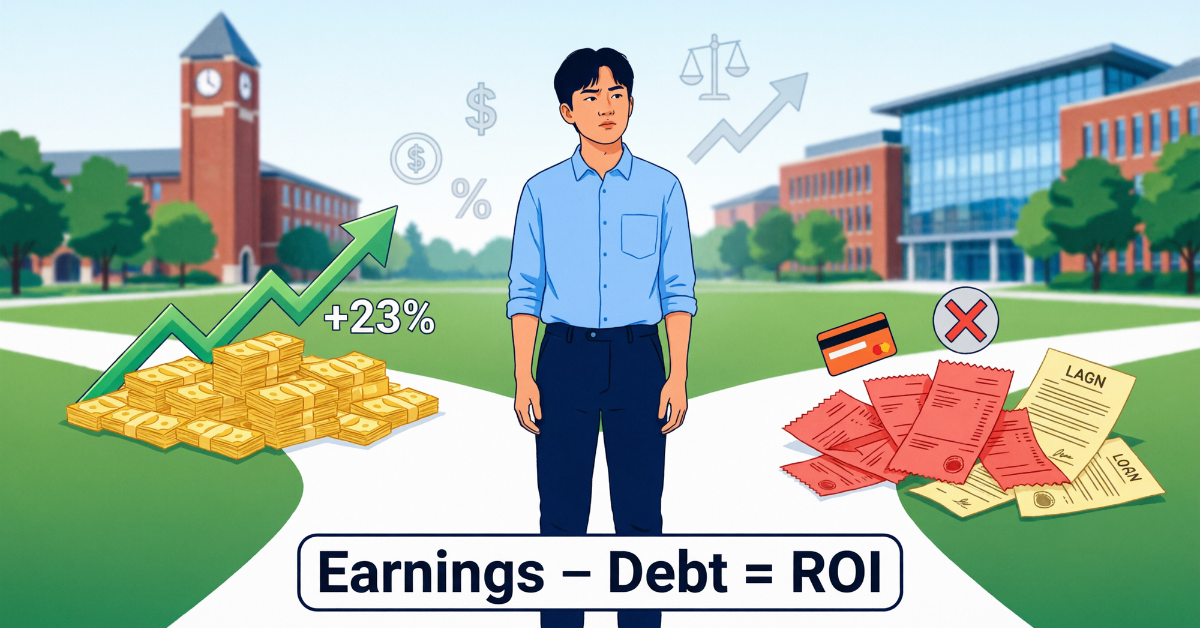
Recent data shows dramatic differences between majors. Some degrees lead to six-figure salaries within a few years, while others may leave graduates struggling to keep up with loan payments. This gap is why ROI has become one of the most important factors for students and families when choosing a college major.
But ROI isn’t just a financial metric—it shapes your lifestyle. A strong ROI can mean buying a home sooner, saving for retirement earlier, and enjoying financial freedom. A weak ROI, on the other hand, can delay major life milestones. So when choosing a degree, understanding ROI isn’t optional anymore—it’s essential.
How Student Debt Impacts ROI
Student debt is the silent factor that can either amplify or destroy your college ROI. Imagine earning a decent salary but having a large portion of your income tied up in loan repayments—that’s where many graduates find themselves. The average student loan interest rate of around 6.39% significantly increases the total cost of a degree over time.
Let’s break it down. If a student borrows around $30,000 to $40,000, they don’t just pay that amount back—they often end up paying tens of thousands more in interest over a 10-year repayment period. That means your degree needs to generate enough income not just to cover your lifestyle, but also to offset that growing debt.
This is where major selection becomes critical. Degrees with lower starting salaries make it harder to manage debt, reducing overall ROI. On the flip side, high-paying fields like computer science or engineering allow graduates to pay off loans faster and start building wealth sooner.

Debt also affects mental well-being and career choices. Many graduates feel pressured to take higher-paying jobs they may not enjoy simply to keep up with payments. Others delay starting businesses, traveling, or even starting families.
So, while college is often seen as an investment in your future, the size and structure of your student debt will heavily influence whether that investment pays off—or becomes a long-term financial burden.
Why Choosing the Right College Major Matters More Than Ever
Rising Tuition Costs and Financial Risk
College tuition has been climbing steadily for decades, and it’s no longer a small financial decision—it’s one of the biggest investments most people will ever make. With tuition, housing, books, and other expenses combined, students can easily spend tens of thousands of dollars per year. That kind of financial commitment comes with real risk.
Choosing the wrong major today doesn’t just mean a less satisfying career—it can mean years of financial strain. The gap between high-ROI and low-ROI degrees has widened significantly, making it more important than ever to think strategically. You wouldn’t invest in a business without researching its potential returns, right? The same logic applies to your education.
Some students still choose majors based purely on passion, which isn’t inherently wrong. But ignoring financial outcomes can lead to difficult trade-offs later. The reality is that not all degrees offer equal economic value, and the job market rewards certain skills more than others.
Economic trends also play a role. Fields tied to technology, data, and engineering continue to grow rapidly, while others may have limited job opportunities or slower salary growth. This makes your major not just a reflection of your interests, but a key factor in your financial future.
In today’s economy, picking a major is less about following a traditional path and more about making an informed investment decision.
Long-Term Financial Impact of Your Degree Choice
Your college major doesn’t just affect your first job—it shapes your financial trajectory for decades. The difference between a high-ROI and low-ROI degree can amount to hundreds of thousands of dollars over a lifetime. That’s not a small gap—it’s life-changing.
For example, graduates in high-paying fields often start with salaries around $70,000 to $80,000 or more, while others may begin closer to $35,000 to $40,000. Even with raises over time, that initial gap tends to widen rather than shrink. Higher earnings allow for better savings, investments, and opportunities.
On the other hand, lower-paying majors can limit financial flexibility. Graduates may struggle to save, invest, or even cover basic expenses comfortably. Over time, this can impact everything from homeownership to retirement planning.
There’s also the concept of opportunity cost. While you’re spending four years in college, you’re not earning full-time income. That makes it even more important that your degree leads to strong earning potential afterward.
That said, financial success isn’t solely determined by your major. Skills, networking, and career choices all play a role. But statistically speaking, your degree sets the foundation.
Choosing a major is like setting the direction of a ship—you can adjust course later, but your starting point matters more than most people realize.
Lowest ROI College Majors: Degrees That Pay the Least
Theology and Religion Majors Explained
When looking at college majors with the lowest return on investment, theology and religion consistently rank near the bottom. That doesn’t mean these fields lack value—they offer deep intellectual, cultural, and philosophical insights—but from a strictly financial perspective, they tend to generate lower earnings relative to the cost of obtaining the degree. And that’s exactly what ROI is measuring: not passion, not fulfillment, but financial return.

Think about it this way: if you invest nearly $40,000 into a degree and spend years paying it off, you need a certain level of income to justify that investment. For theology graduates, the career paths—such as ministry, nonprofit work, or academia—often come with modest salaries, especially early on. These roles can be meaningful and impactful, but they don’t always provide the financial upside needed to offset student debt quickly.
Another factor is job demand. Unlike fields such as technology or healthcare, where demand is booming, theology-related careers are relatively niche. This can make the job market more competitive and limit salary growth. Some graduates may even need additional degrees to access higher-paying roles, which adds more cost and delays financial returns.
That said, it’s important to avoid oversimplifying the picture. ROI doesn’t capture everything. Many theology majors pursue their field out of a sense of calling or purpose, which can outweigh financial considerations. Still, for students weighing cost versus income potential, this major represents a higher financial risk compared to others.
Understanding this gap isn’t about discouraging certain paths—it’s about helping students make informed decisions. If you’re passionate about theology, pairing it with another skill set or pursuing cost-effective education options could help balance passion with financial sustainability.
Average Debt, Salary, and 10-Year Profit
Let’s break down the numbers to see why theology and religion rank as a low-ROI college major. According to data from the Education Data Initiative, students pursuing this degree typically graduate with around $38,722 in student loan debt. That might not seem extreme compared to some programs, but the challenge lies in repayment relative to income.
With an average interest rate of 6.39% on undergraduate loans, the total repayment amount over 10 years climbs to approximately $52,502. That’s a significant increase from the original loan amount, and it highlights how interest can quietly inflate the cost of your education.
Now, here’s where ROI comes into play. Over a 10-year period, theology graduates can earn a total income that leads to an estimated profit of $442,500 after accounting for loan repayment. On the surface, that may sound like a strong number—and in absolute terms, it is. But when compared to other majors, it’s relatively low.
To put it into perspective, this results in an ROI of around 842.83%, which is significantly lower than high-performing majors like computer science. The difference isn’t just in percentage terms—it translates to hundreds of thousands of dollars over time.
Here’s a quick comparison:
| Metric | Theology Major |
|---|---|
| Average Student Debt | $38,722 |
| Total Repayment (10 Years) | $52,502 |
| 10-Year Profit | $442,500 |
| ROI | 842.83% |
These numbers reveal an important truth: even though theology graduates do earn a profit, the rate of return is much lower, meaning it takes longer to achieve financial stability and build wealth.
Highest ROI College Majors: Degrees That Pay the Most
Why Computer Science Dominates ROI Rankings
If theology sits at one end of the ROI spectrum, computer science is firmly planted at the other. Year after year, it ranks as one of the highest-paying and most in-demand college majors, and the financial returns reflect that dominance. The reason is simple: the world runs on technology, and the demand for skilled developers, engineers, and data professionals continues to surge.
Computer science graduates often start their careers with salaries around $80,000 per year, and in many cases, even higher depending on location and specialization. That kind of income right out of the gate creates a powerful financial advantage. It allows graduates to pay off student loans faster, invest earlier, and build wealth at a much quicker pace.
But it’s not just about high salaries—it’s also about relatively lower student debt. Compared to some other fields, computer science programs often have a better balance between cost and earning potential. This combination of high income and manageable debt is what drives the exceptional ROI.
Another key factor is career flexibility. A computer science degree opens doors to multiple industries—tech, finance, healthcare, entertainment, and more. This versatility reduces the risk of unemployment and increases opportunities for salary growth.
In a digital-first economy, skills like programming, data analysis, and software development aren’t just valuable—they’re essential. That’s why computer science continues to outperform most other majors in terms of ROI.
Salary Growth and Low Debt Advantage
The numbers behind computer science ROI are hard to ignore. With an estimated ROI of 2,899.45%, this major significantly outperforms nearly every other field. That’s not just a marginal difference—it’s a massive leap that translates into real financial impact over time.
Graduates typically repay around $31,434 in student loans over 10 years, which is actually lower than many other majors. Combine that with a strong starting salary and consistent demand, and you get a powerful financial equation.
Over a decade, computer science graduates can generate an estimated $911,426 in profit, nearly double that of theology majors. This gap highlights how choosing the right major can dramatically change your financial future.
| Metric | Computer Science |
|---|---|
| Average Student Debt | Lower than average |
| Total Repayment (10 Years) | $31,434 |
| 10-Year Profit | $911,426 |
| ROI | 2,899.45% |
The advantage doesn’t stop there. Many tech roles offer additional perks like bonuses, stock options, and remote work flexibility. These benefits further enhance overall compensation and quality of life.
Still, it’s worth noting that computer science isn’t easy. It requires strong analytical skills, continuous learning, and adaptability. But for those who are willing to invest the effort, the financial rewards can be substantial.
Engineering Majors and Their Strong Returns
While computer science often steals the spotlight, engineering degrees are not far behind when it comes to ROI. Fields like mechanical engineering, electrical engineering, and civil engineering consistently deliver strong salaries and stable career paths, making them some of the safest bets for students focused on financial outcomes.
Engineering graduates typically enter the workforce with competitive salaries, often ranging between $65,000 and $85,000 annually depending on specialization. These earnings grow steadily over time, supported by demand in industries such as construction, manufacturing, energy, and technology.

One of the biggest advantages of engineering majors is their balance between cost and earning potential. While tuition costs can be similar to other degrees, the return is significantly higher due to strong job placement rates and reliable income growth.
Another key strength is job stability. Engineering skills are highly transferable and remain in demand even during economic downturns. This reduces the risk of unemployment, which is an often-overlooked factor in ROI calculations.
In terms of long-term financial performance, many engineering majors produce high six-figure profits over a 10-year period, placing them firmly among the top ROI degrees.
For students who enjoy problem-solving, design, and innovation, engineering offers a compelling mix of intellectual challenge and financial reward. It may not always match the explosive growth of tech salaries, but it provides a steady and reliable path to financial success.
Comparing College Graduates vs High School Graduates
10-Year Earnings Comparison
One of the most common questions students ask today is simple but loaded: Do I really need a college degree to earn more money? The answer, backed by data, is still yes—but the full story is more nuanced than it first appears. When comparing college graduates vs high school graduates earnings, the gap over time becomes increasingly clear, especially when you zoom out over a 10-year period.
Let’s start with the baseline. The median annual salary for a high school graduate begins at around $35,500 per year. If we assume a modest annual wage growth of about 3.6%, which reflects typical increases due to experience and inflation adjustments, a high school graduate would earn approximately $418,394 over 10 years. That’s a respectable figure, especially for someone who avoided student debt and entered the workforce earlier.
Now compare that to a college graduate. Even after factoring in student loan repayments, the average college graduate earns about $612,241 over the same 10-year period. That’s nearly a $200,000 difference, which is not just a statistical gap—it’s a lifestyle gap. It can mean the difference between renting and owning a home, between living paycheck to paycheck and building long-term savings.
But here’s where it gets interesting. This advantage isn’t evenly distributed across all majors. Some degrees dramatically outperform this average, while others barely exceed high school earnings. That’s why ROI matters so much—it helps differentiate between degrees that truly pay off and those that may struggle to deliver financial returns.
Another layer to consider is timing. High school graduates start earning immediately, while college students spend four years (or more) investing in education. That’s four years of lost income, which adds to the opportunity cost of a degree. However, over time, the higher earning potential of a college graduate typically outweighs this early advantage.
The takeaway? A college degree still offers a significant financial edge, but the size of that edge depends heavily on your choice of major.
Is College Still Worth the Investment?
With rising tuition costs and growing student debt, skepticism about higher education is at an all-time high. So it’s fair to ask: Is college still worth it in 2026? The honest answer is—it depends. Not all degrees are created equal, and blindly pursuing a college education without considering ROI can lead to disappointing outcomes.
From a purely financial perspective, the data still supports the value of a college degree. On average, graduates earn significantly more over their lifetimes compared to those with only a high school diploma. This increased earning potential provides greater financial security, better job opportunities, and more career flexibility.
However, the risk factor has increased. Tuition costs have risen faster than wages in many fields, meaning students must be more strategic than ever. Choosing a major with low earning potential while taking on substantial debt can lead to a situation where the degree doesn’t pay for itself for many years—if at all.
There’s also the issue of underemployment. Some graduates end up working in jobs that don’t require a degree, which reduces the effective ROI of their education. This is particularly common in fields with limited job demand or oversaturated markets.
Still, college offers benefits beyond salary. It can provide networking opportunities, personal growth, and access to careers that would otherwise be out of reach. The key is to approach it as an investment decision, not just a default next step after high school.
For students willing to research, plan, and choose wisely, college remains one of the most powerful tools for upward mobility. But the margin for error is smaller than ever.
Hidden Factors That Affect ROI Beyond Salary
Unemployment Rates by Major
When people evaluate the best college majors for ROI, they often focus heavily on salary—and for good reason. But income is only part of the equation. A high-paying degree doesn’t mean much if you struggle to find a job in the first place. That’s where unemployment rates by major come into play, adding another critical layer to the ROI conversation.
Surprisingly, some majors with strong reputations also come with unexpectedly high unemployment rates. For example, data shows that both anthropology and even computer science graduates can experience unemployment rates that are equal to or higher than individuals aged 22 to 27 without a college degree. That might sound counterintuitive, especially for computer science, but it highlights an important reality: demand for skills doesn’t always translate to immediate job placement.

Why does this happen? In some cases, it’s due to skill gaps. Employers may expect graduates to have hands-on experience, internships, or specialized knowledge that isn’t always covered in a standard curriculum. In other cases, geographic location plays a role—job opportunities may be concentrated in certain cities, making it harder for graduates elsewhere to find work.
Unemployment directly impacts ROI because it delays income generation. Every month spent job hunting is a month without earnings, while student loan interest continues to accumulate. This can significantly reduce the overall financial return of a degree.
The lesson here is clear: when choosing a major, don’t just look at average salaries—look at employment rates, job demand, and required skills. A slightly lower-paying field with strong job stability can sometimes offer a better ROI than a high-paying but volatile one.
Cost of Education and Time to Graduate
Another often overlooked factor in calculating college ROI is the actual cost of education—and how long it takes to complete your degree. While many ROI models assume a standard four-year timeline, reality doesn’t always follow that script. In fact, a significant number of students take five or six years to graduate, which can dramatically increase costs.
Every additional year in college means more tuition, more living expenses, and more lost income. It also delays entry into the workforce, which reduces the total amount you can earn over time. This extended timeline can quietly erode the financial benefits of even a high-paying degree.
The type of institution you choose also plays a major role. Students who attend expensive private universities without financial aid often graduate with significantly higher debt. According to insights from the Federal Reserve Bank of New York, these students tend to experience lower ROI, even if their post-graduation salaries are competitive.
Here’s where strategy becomes important. Attending a more affordable school, applying for scholarships, or starting at a community college before transferring can significantly reduce overall costs. These decisions don’t just save money—they improve your ROI from day one.
It’s also worth considering the concept of efficiency. Graduating on time, minimizing unnecessary expenses, and choosing a major with a clear career path can all enhance the financial return of your education.
In short, ROI isn’t just about what you earn—it’s about what you spend and how efficiently you get there. Even small decisions along the way can have a lasting impact on your financial future.
Methodology Behind ROI Calculations
Data Sources and Assumptions
Understanding how college ROI rankings are calculated is just as important as the rankings themselves. Without knowing the methodology, it’s easy to misinterpret the numbers or assume they tell the whole story. In reality, ROI is built on a set of assumptions, data points, and projections that aim to estimate financial outcomes—but they’re not guarantees.
The analysis referenced here relies primarily on data from two key sources: the Education Data Initiative and the Federal Reserve Bank of New York. The Education Data Initiative provides estimates for average student loan debt by major, which serves as the “investment cost” side of the equation. Meanwhile, the Federal Reserve Bank of New York offers data on median early-career salaries by bachelor’s degree type, which is used to project earnings.
To calculate ROI, analysts typically compare the total cost of repaying student loans (including interest over a standard 10-year repayment plan) with the total income earned over the same 10-year period. The difference between these two figures represents the “profit,” while the ratio between cost and gain determines the ROI percentage.
For example, if a graduate earns $600,000 over 10 years and pays $50,000 in total loan repayments, the net gain is $550,000. That figure is then used to calculate the ROI percentage, giving a standardized way to compare different majors.
However, these calculations come with limitations. They assume consistent employment, steady salary growth, and standard repayment plans. They don’t account for career changes, economic downturns, or personal circumstances that could significantly alter financial outcomes.
Another key limitation is that these models focus heavily on early-career earnings. While this provides a useful snapshot, some careers—especially in fields like education, healthcare, or academia—may have slower salary growth initially but improve significantly over time.
So while ROI rankings offer valuable insights, they should be viewed as guidelines rather than absolute truths. They’re most useful when combined with personal goals, interests, and a realistic understanding of the job market.
Conclusion: How to Choose a High-ROI Degree
Choosing a college major is no longer just about passion or curiosity—it’s about strategy. The data clearly shows that the best college majors by ROI, such as computer science and engineering, offer significantly higher financial returns compared to fields like theology and religion. But the decision isn’t as simple as picking the highest-paying option.
A smart approach balances interest, ability, and financial outcome. After all, a high-paying career won’t feel sustainable if you dislike the work, just as a passion-driven path can become stressful if it leads to financial instability. The goal is to find that middle ground where your skills align with market demand.
It’s also crucial to think beyond just salary. Factors like job stability, unemployment rates, cost of education, and time to graduate all play a role in shaping your overall ROI. A slightly lower-paying field with strong demand and low debt can sometimes outperform a higher-paying but riskier option.
Another important takeaway is that college is still worth it for most people—but only when approached thoughtfully. The nearly $200,000 earnings gap between college graduates and high school graduates over 10 years highlights the long-term value of higher education. However, that value depends heavily on the choices you make along the way.
If you’re planning for college, treat it like an investment. Research your options, understand the numbers, and consider both the short-term costs and long-term rewards. Because at the end of the day, your degree isn’t just a piece of paper—it’s a financial decision that can shape your future for decades.
FAQs About College ROI and Degree Value
1. What is the best college major for highest ROI?
The best college major for ROI is typically computer science, with an ROI of nearly 2,900% based on 10-year earnings and debt repayment data. Other strong contenders include engineering fields like electrical, mechanical, and chemical engineering, all of which offer high salaries and strong job demand.
2. Which college major has the lowest ROI?
Theology and religion majors rank among the lowest ROI degrees, with an estimated ROI of around 842.83%. While still profitable in absolute terms, these majors tend to have lower salaries relative to student debt, resulting in weaker financial returns.
3. Is college worth it compared to joining the workforce after high school?
Yes, on average, college graduates earn significantly more than high school graduates. Over a 10-year period, college graduates earn დაახლოებით $612,000, compared to about $418,000 for high school graduates, even after accounting for student loan payments.
4. How does student debt affect ROI?
Student debt reduces ROI by increasing the total cost of education. Higher interest rates and longer repayment periods can significantly impact net earnings, making it essential to choose a major with strong earning potential or minimize borrowing where possible.
5. Can a low-ROI major still be a good choice?
Absolutely. A low-ROI major can still be worthwhile if it aligns with your passions and career goals. However, it’s important to manage costs carefully, consider double majors or additional skills, and plan for realistic salary expectations to maintain financial stability.